Thursday, October 17, 2013

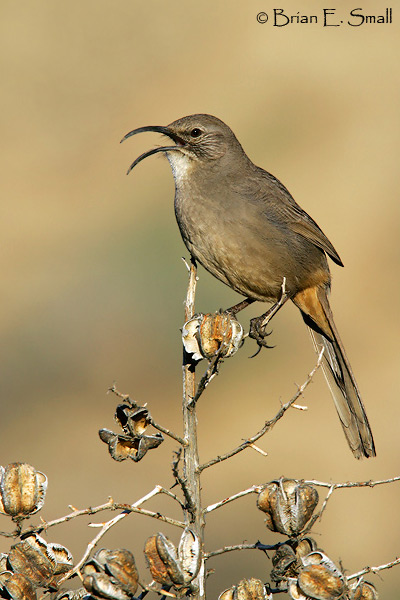
One for the Home Team--California Thrashers


http://www.briansmallphoto.com/images/California-Thrasher_B9H9215.jpg
 http://www.briansmallphoto.com/images/California-Thrasher_B9H9215.jpg   
 further information-
 http://birds.audubon.org/birds/california-thrasher
   
      Funny birds inspire some birders to get funny too. Here come the nose jokes. (Okay, so I surfed around and there's not a lot of thrasher humor but there are some comical descriptions of "loud" looking  woodpeckers). This bird fits right in with any of your colorful California characters. I had to look twice and laughed out loud when I first spotted the thrasher in the chaparral of Almaden Valley's foothills. Its beak was so long and awkward looking! The bird's overall shape, or silhouette, makes it a quick study in your field guide. Once you've encountered the bird, you know it and remember it. Another funny trait it has besides its looks is its way of sprinting bouncily away from you with its tail up rather than fly off to escape. I saw one yesterday at Ulistac Natural Area (Santa Clara) towering over some sparrows. All of the birds were tossing around leaf litter for seeds and insects. The thrasher rakes with the prominent tool on its head uncovering insects and other invertebrates to eat. These birds are residents of California or Baja California chaparral country. As the thrasher sped away from me, I could make out its light cinnamon belly and undertail coverts. Ground foragers like thrashers and towhees are always a relief for my neck after I've been craning it up to look skyward at hawks and other high flyers. And here's a little bonus factoid from whatbird.com: "It (the thrasher) has been observed standing on nests of carpenter ants and allowing them to run over its body and through its feathers, a behavior known as anting." Anting is also odd. Biologists hypothesize that birds that do this are performing their own way of ridding themselves of mites and lice and bacteria. Some rub themselves with ants, then eat those ants once they have leaked out biocidal secretions onto the bird's skin.

Wednesday, October 16, 2013

The "Little Brown Jobs" LBJs

  If you want to set off a migraine, then go out in the field and try your hand at distinguishing the numerous races of sparrow out there. You might assume there is a limited way to combine grey, brown, white and black patterns in a bird, but there is not. It was probably a perplexed ornithologist in the midst of organizing the sparrow section who coined the term "Little Brown Job," to heap countless small, somewhat plain, and easily confused species. Can't you just see him now? It's well past lunchtime and his brow is furrowed under a sage-toned canvas hat. His vision is blurring, stomach growling, and he just sighs and shuts his sketchpad; "Oh for now, they're all just LBJs!" Thankfully, the White-crowned Sparrow has a crown of neat black and white stripes to tip us off on our birdwalk. I spotted a few amidst the cruising bushtits and a handful of finches yesterday afternoon along the Los Gatos Creek Trail. They would have blended into the bare tree limbs but for the crown's eye-catching white. Wait! Before you breathe a sigh of relief-- There are indeed several races of the White-crowned Sparrow...but she's not going to fly onto your finger and let you riffle her crown to see which one she is, so we shall leave it at that and let the obsessives handle it from here.

Monday, October 14, 2013

Anna's Hummingbird


The male Anna Hummingbirds can be colorful characters. - grid24_6
Las Pilitas Nursery


Hotlips Salvia
The Anna's Hummingbird dropped in on me as I watered the autumn blooming Hotlips Salvia as if to ask me, "What is your business here? This is mine." She is possessive about her favorite red flowers. As she tilted her wee body slightly in the last of the day's sunlight (it was already past 6 pm), her gorget, or throat patch, glowed a delicious raspberry hue nearly matching the red of the many blossoms luring her. She whirred only inches from my eyes as I stooped with my waterhose in the superfast way they have of flying in place (an optical oxymoron? Can you physicists explain it?). How are they in frenetic motion and also stationery? Annas ruffled out her skirt out and stared at me from her grey eyes over her long, needle-thin beak . If you can hold yourself still, they keep on flower feeding right in front of your nose. These tiny birds have no time in their schedules to waste and must fuel their quick metabolisms: They require a few times their body weight in nectar daily. BzrrrrrrrrWhrrrrrrrr drum the mighty wings. And when she is done she streaks across the sky in an arc and is up and over the next houses and across the street in about two winks. She is not cowed at all by your size and will take brief and keen interest in your hat if it's red, orange, or some other bright color attractive to her. She will let anyone in her domain know if they are infringing on what is hers, her mapped and crucial nectar spots. This magical and tiny bird is a delight in the garden. I don't have to venture very far to encounter her here winter, spring, summer or fall. Have you ever noticed the energy hummingbirds exert defending a feeder that isn't even hung up but they have recently visited? Indeed, she is a diligent, boldhearted, astonishing bird.                                                                                                                                                                       

Saturday, October 12, 2013

Gulls with Geese

Waterbird Mixer
"Birds of a feather flock together," except for when they flock with birds largely unlike themselves. Canada Geese and gulls share the lawn at Penitencia Creek Park located at the bottom of San Jose's eastern foothills. Remember, when you flock among birder friends and associates, do not spout the old "two birds with one stone" saw. Bird lovers frown upon it. Binoculars, cameras, sketchpads, and naked eyes, yes! Stones, BB guns and slingshots, no! While we are on the subject of bird inspired proverbs, two birds in the bush is very fine. Identify this bush, sneak up close to this bush and catch a glimpse of the birds. Yes, some people will stare at you. What colors do you see? What are the birds exclaiming from the bush? Birds of a size often flock together, but that just won't cut it as a popular saying. Little birds like chickadees and titmice all in brisk cheeping cliques defy our cute saying. Or else birds of a common habitat and habits flock together like these geese and gulls. Birds will be birds and don't bother themselves too much with our generalizations about them. What do they do? We can find out by stepping outside and watching them. We may observe something new or puzzling about their lives.

Friday, October 11, 2013

'Name-Tag' Birds


 Isn't it fantastic when you need not consult your field manual to reference a bird you've identified a number of times already? There are some birds who announce themselves by their call or by plumage details; such is the Yellow-rumped Warbler who gives itself away with a flash of bright yellow from its rump as it flits away with a decisive, or perhaps, it is a bothered, 'chit.' They go round in loose flocks, so you are likely to hear chit, chit, chit from various spots overhead as you stroll through your neighborhood on alert for visiting birds. Sibley's ear hears 'chwit,' but I am just starting to tune my ear to the dialectical distinctions of common urban birds. It's best to ask your own ears what sounds they hear as soon as you sight the bird. You can file it in your brain's audio input as you learn and store away the bird's name. Later, just by listening to songs and calls you may be able to name the birds all around you. It can also be fun to dispute your bird guide on pronunciation since, really, isn't it your own trusted ears against Sibley's or Peterson's or whoever may be your preferred Last Word on the Bird? When the Yellow-rumped Warblers come through in fall to rustle the Chinese Pistache trees, gleaning the sticky pinkish drupes for insects, their pretty swatches of yellow offer up a satisfying memory aid. I thrill with recognition, "I know that bird!" No--not a sparrow or a bushtit: too much yellow with sharper lines than a sparrow, a little long in the tail and wing-streaked for a bushtit. As soon as you spot its yellow rump flag, you can be certain it's a Yellow-rumped Warbler. It's as sure a marker as the cotton ball you espy on the hindquarters of the cottontail as she hops under a shrub. I like to think of these warblers as birds that 'ring a bell.'