Friday, November 1, 2013

Gulls: What's so Special about a "Seagull"?

tgreybirds.com (California gulls)
   I am able to drink up sea water and expel the salt with a pair of salt glands located in my head above my eyes. Super salty water is absorbed from my bloodstream and excreted through the glands down my beak, trickling out my nostrils. Did you know I have this magic? Did you know we birds have nostrils?
 
www.kiwifoto.com
  I saw many gulls in their great colonies on the mudflats at Alviso Marina County Park. Ho-hum, seagulls; of course I kept my eyes peeled for something less ordinary. The ones pictured here, in an apparent embrace, are Western gulls, residents of the Pacific Coast. Many types of seagull (and people probably won't stop calling them that despite birders' urgency for accuracy) are birds I see daily without looking for them as they fly high overhead or float around on a city pond or take leftovers off the schoolyard. Birders are ever in pursuit of that rare sighting, but, for me, there is no ordinary bird. Gulls too possess their secrets.

http://www.pbase.com/tgrey/yard  Tom Grey has a helpful, friendly website with amazing photographs he took of many types of birds. Check this out!

Wednesday, October 30, 2013

Bushtits, or no see 'ums

North Coast Land Conservancy/Teresa
If you are reborn as a bushtit, you will never have to be alone. Bushtits travel in fluffed out little bands of ten, seventeen, twenty, forty, and then some. There isn't a creature such as the Lone Bushtit. They are the heart of sociability. They are dark, restless little forms like commas or apostrophes in a tree. Their bodies are small like several cotton balls stuck together with a longish tail tacked on. Psaltriparus minimus is their "proper," Latin name. Minimus would be a fitting name for one of those teensie chihuahuas or a parakeet, or maybe for a large pit bull or giant goldfish. "Minimus, down!" These birds are accomplished knitters binding thready green, grey knee socks in trees to hatch and raise their young inside. Their nests are long, coarse, flexible, spongy tapestries of moss, webs, animal hair and other filaments the pair weaves together on the outer limbs of trees. They are remarkable in the nest world and unique. The hanging shelters would seem to have been blown there and snagged by the tree except for the little cheeps and shaking of the lichen threads when the bushtitties are active. If I were a bushtit to-be, I would be warm, dry and happy in my sleeping bag, with its inner lining of feathers right where my bushtit tush fits. The parents climb in through a small opening at the top of the tube sock and pick their way down with insects for their nestlings. A perfect arrangement, in all.                                               

Monday, October 28, 2013

Sharp-shinned Hawk


http://www.pinterest.com/pin/132363676521127807


 I was walking at dusk by the Chinese statuary and birdbath sales yard near Kelley Park Zoo. I figured it was a bit dark to bird anymore and I wasn't likely to see anything "special" out in front of a 7-11 on a busy intersection. I wasn't paying any particular attention, but some swift motion, or it could have been a powerful presence, up to my left drew my eye. I looked up and there perched on a billboard was a Sharp-shinned Hawk taking a look on the birdbath and street scene below. I find the element of surprise keeps birdwatching new and exciting. Sometimes I surprise the bird and other times I am the one caught by surprise. Sharp-shinned Hawks are small birds of prey and they hunt passerines (perching birds) on the wing. They  also eat small mammals, an occasional reptile or amphibian, as well as large insects such as dragonflies. The "Sharpie" I saw was poised forward, his eyes fixed on the tree canopies for his end of day catch. He had handsome colors like the one here pictured with the rusty and white speckled breast and slate back. They have a reputation for taking food to-go from backyard birdfeeders, but wouldn't you? Hard to pass the buffet table without taking a nibble or two of the offerings...A bustling birdfeeder must be the Sharped shinned Hawk's idea of a QuickieMart stop.


howardsview.com (immature Sharp-shinned)
                                                                                                               

Thursday, October 24, 2013

Tricks of Light and Feathers, The Steller's Jay

Blue- and black-colored bird (Steller's jay)
 'BR' of Yosemite NP


Birdgirrl

   The Steller's Jay is the boisterous bird that  hops right across your picnic table to snatch a pretzel or peanut. They are often in campgrounds making a racket in trees surrounding your tent in oak/pine and coniferous woodlands. It has a long black crest (mohawk) and a garrulous, bold nature. You may find one of its feathers on the trails, and it takes some restraint to leave it there. These attractive and faintly black-striped feathers contain no blue pigmentation! Their blue is an optical effect which is due to "structural coloration." "There is no blue pigment in bird feathers- instead, the color results from the way light interacts with nanoscale bubbles in the feather barbs" (Schmoker, Bill). Jays belong to the Corvidae family and are grouped along with songbirds, but not for their singing ability, because they sound like squawkers and screechers. You won't have to tiptoe or creep around to see a Steller's Jay because he or she will not shy away. They may pick a fight with you if you loiter around their nests. I have had my hair messed up by another species in this family, the Western Scrub-Jay. If you can't get enough on avian coloration...

National Geographic Bird Coloration  by Geoffrey Edward Hill

http://www.nps.gov/yose/blogs/Stellers-Jay-Coloration.htm

Monday, October 21, 2013

White Pelicans: Aerial Ballet


John Young
http://static.photo.net/attachments/bboard/00A/00AyY1-21650384.JPG
and, view:
http://www.monolake.org/today/wp-content/uploads/2011/04/amwp_21.jpg

   White Pelicans are overwintering along the Pacific Coast and the Gulf of Mexico. They are the second largest bird of North America with their 9' wingspans, longer than any of our tallest basketball players! Most people recognize them as the bird with the long, flat orange bill and flexible pouch attached to the lower mandible. At first glance from afar, you might mistake a flock of pelicans for gulls with their flashing white forms, but look again through a pair of binoculars. There is nothing quite like their slow, "ponderous," quiet, dramatic presence high above. They are a rewarding sight with their wings' black edging, their mighty downstrokes, and their graceful leisurely soaring. They are sky dancers flowing as one body in a "unified wheeling"(http://birds.audubon.org/). They make the elitest Swan Lake Corps de Ballet look like a troupe of stumblers. This is a bird both "improbable" or "semi-comical" in its dimensions who, nevertheless, achieves an overall effect of grace and power. We, a stray assortment of birders, saw some 70 of them rising on thermal air columns from the vantage point of Ulistac Natural Area a few miles inland from Don Edwards Baylands Trail National Wildlife Refuge (http://www.fws.gov/refuge/Don_Edwards_San_Francisco_Bay/map.html.) Each of us was silent and transfixed for a few breaths. I live on the Pacific Flyway, hooray! Take a walk anywhere on the SF Baylands Trail system in the South Bay to look at waterbirds of all shapes, colors, sizes, and squawks.

Thursday, October 17, 2013

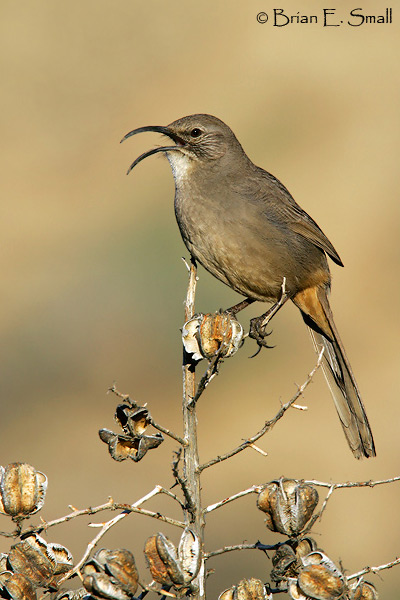
One for the Home Team--California Thrashers


http://www.briansmallphoto.com/images/California-Thrasher_B9H9215.jpg
 http://www.briansmallphoto.com/images/California-Thrasher_B9H9215.jpg   
 further information-
 http://birds.audubon.org/birds/california-thrasher
   
      Funny birds inspire some birders to get funny too. Here come the nose jokes. (Okay, so I surfed around and there's not a lot of thrasher humor but there are some comical descriptions of "loud" looking  woodpeckers). This bird fits right in with any of your colorful California characters. I had to look twice and laughed out loud when I first spotted the thrasher in the chaparral of Almaden Valley's foothills. Its beak was so long and awkward looking! The bird's overall shape, or silhouette, makes it a quick study in your field guide. Once you've encountered the bird, you know it and remember it. Another funny trait it has besides its looks is its way of sprinting bouncily away from you with its tail up rather than fly off to escape. I saw one yesterday at Ulistac Natural Area (Santa Clara) towering over some sparrows. All of the birds were tossing around leaf litter for seeds and insects. The thrasher rakes with the prominent tool on its head uncovering insects and other invertebrates to eat. These birds are residents of California or Baja California chaparral country. As the thrasher sped away from me, I could make out its light cinnamon belly and undertail coverts. Ground foragers like thrashers and towhees are always a relief for my neck after I've been craning it up to look skyward at hawks and other high flyers. And here's a little bonus factoid from whatbird.com: "It (the thrasher) has been observed standing on nests of carpenter ants and allowing them to run over its body and through its feathers, a behavior known as anting." Anting is also odd. Biologists hypothesize that birds that do this are performing their own way of ridding themselves of mites and lice and bacteria. Some rub themselves with ants, then eat those ants once they have leaked out biocidal secretions onto the bird's skin.

Wednesday, October 16, 2013

The "Little Brown Jobs" LBJs

  If you want to set off a migraine, then go out in the field and try your hand at distinguishing the numerous races of sparrow out there. You might assume there is a limited way to combine grey, brown, white and black patterns in a bird, but there is not. It was probably a perplexed ornithologist in the midst of organizing the sparrow section who coined the term "Little Brown Job," to heap countless small, somewhat plain, and easily confused species. Can't you just see him now? It's well past lunchtime and his brow is furrowed under a sage-toned canvas hat. His vision is blurring, stomach growling, and he just sighs and shuts his sketchpad; "Oh for now, they're all just LBJs!" Thankfully, the White-crowned Sparrow has a crown of neat black and white stripes to tip us off on our birdwalk. I spotted a few amidst the cruising bushtits and a handful of finches yesterday afternoon along the Los Gatos Creek Trail. They would have blended into the bare tree limbs but for the crown's eye-catching white. Wait! Before you breathe a sigh of relief-- There are indeed several races of the White-crowned Sparrow...but she's not going to fly onto your finger and let you riffle her crown to see which one she is, so we shall leave it at that and let the obsessives handle it from here.